This week, I've seen the word definitely spelled wrong about 10 times.
Since this is such a common error, I thought I would take this opportunity to say that if you are spelling definitely as definately, you are definitely wrong!
Why does this happen? I think it has to do with pronunciation. Many people pronounce the term as deaf-in -at-ly instead of deaf-in-net-ly. (Yes, I added the "a" in "deaf" deliberately for phonetics.)
An easy way to remember the correct spelling is to think of the word define. If you remember define, you'll be fine!
Sorry, couldn't pass up the great chance to use that corny pun.
Thursday, April 22, 2010


Friday, April 9, 2010
Today's Writing Tip -- Talking Italian
Recently, I heard someone on the radio use this line: "It's a bunch of bunk, what the media is trying to feed you." That really made me laugh. I grew up in New Jersey and learned Soprano-speak early on. There is a certain way that ethnic groups, particularly first-generation Italians, will phrase their sentences that makes sense in their language but appears backwards in English. This is a prime example.
If we reverse that sentence, it would read, "What the media is trying to feed you is a bunch of bunk." That's sounds much more straightforward and familiar to us.
This is the kind of error that is made more frequently in speech than in writing, but if English is not your first language, you may want to have someone else review your copy if you're blogging or writing an important article.
And if English is your first language, stop talking Soprano! Tony has ways of punishing you from the great beyond.
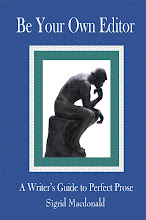
Sigrid Macdonald is the author of three books, including Be Your Own Editor which will be released soon by TotalRecall Press in Texas. You can buy it from her directly for $17.99 by sending an e-mail and using PayPal.
Wednesday, March 31, 2010
Try to Practice This!
Today's Writing Tip -- Many of my clients use words like try, begin, or start. Often these words dilute the meaning of a sentence, especially when they're used repeatedly. Here's an example: "Ben said that he was going to begin writing his essay." Unless you want to emphasize the fact that he is just starting, a cleaner sentence would read, "Ben said he was going to write his essay."
Likewise with the word try. Often in the motivational speaking world or New Age movement, people like Wayne Dyer or Tony Robbins advise doing away with the word try altogether. Don't try, just do it! Using poor Ben again, we could rephrase that sentence by saying, "Ben said that he was going to try to write his essay." If it's written that way, we have a mental picture of Ben struggling. It's even worse to say, "Ben said that he was going to try beginning writing his essay," because that's a long sentence that's bogged down by too many words. A cleaner sentence would read, "Ben said he was going to write his essay," or " Ben is writing his essay." We don't always need the word going either.
Be aware of words that slow down your sentences or dilute your meaning. There are definitely times that we want to emphasize someone trying, particularly when that person may fail. Or we want to highlight the fact that someone is beginning something because it's brand-new. But frequently, we can do without those terms.
Buy Be Your Own Editor directly through me by hitting the Contact Me button or sending an e-mail to sigridmac at rogers.com. Or simplifiy your life and get it on PayPal.
Sunday, March 21, 2010
Today's Writing Tip is on How to Use the Words First, Second and Third
If you use the word first, remember to follow with the words second or third. For example, "There are many advantages to living in Florida: first, the sun shines all year round. Second, you don't have to devise a budget for snow removal." If you use the word first and neglect to say second or third afterwards, it doesn't make sense and your reader will notice that something is missing.
Buy Be Your Own Editor directly through me by hitting the Contact Me button or sending an e-mail to sigridmac at rogers.com. Or simplifiy your life and get it on PayPal.
Buy Be Your Own Editor directly through me by hitting the Contact Me button or sending an e-mail to sigridmac at rogers.com. Or simplifiy your life and get it on PayPal.
Sunday, March 7, 2010
Today's writing tip is on misplaced modifiers.
What is a misplaced modifier? It's a word that modifies (or clarifies or qualifies) the wrong thing. Here's an example: "Joe almost barbecued all of the chicken." What is the writer trying to say here? "Almost barbecued" means that the food was only half done. Was the chicken raw? Unlikely. The writer probably meant to say, "Joe barbecued almost all of the chicken." That means that there was still some chicken that hadn't been barbecued.
Just recently, I told a friend I had enjoyed visiting my brother and hanging out in his garden with the dog and his wife. When did the dog suddenly get a wife? I was just too lazy to correct that sentence in e-mail but it should have read, "I had fun hanging out in my brother's garden, talking to his wife and playing with the dog." Then no one would be confused about the marital status of dogs.
Buy Be Your Own Editor directly through me by hitting the Contact Me button or sending an e-mail to sigridmac at rogers.com. Or simplifiy your life and get it on PayPal.
Today's writing tip is on double negatives
I was listening to a local radio station recently -- I won't give you the name because I never kiss and tell -- and one of the announcers was talking about the Nortel pension crisis. He said, "Most people are not going to get nothing." Using a double negative is always awkward. My announcer would have been better off saying, "Most people are going to get something." Not only does that sentence work better grammatically, but it also leaves the listener with a more positive impression about pension funds.
Buy Be Your Own Editor directly through me by hitting the Contact Me button or sending an e-mail to sigridmac at rogers.com. Or simplifiy your life and get it on PayPal.
Buy Be Your Own Editor directly through me by hitting the Contact Me button or sending an e-mail to sigridmac at rogers.com. Or simplifiy your life and get it on PayPal.
Tuesday, March 2, 2010
One Word or Two -- Anymore or Any More
Today's Writing Tip -- when should you use anymore or any more? "I don't want any more snow!" means you don't want *additional* snow (and you're in good company). "I don't want to live someplace where it snows anymore" means you don't want to live in a cold weather climate *any longer.* "I'm dying for more snow" means you are a masochist if you live in New York or D.C.
Buy Be Your Own Editor directly through me by hitting the Contact Me button or sending an e-mail to sigridmac at rogers.com. Or simplifiy your life and get it on PayPal.
Buy Be Your Own Editor directly through me by hitting the Contact Me button or sending an e-mail to sigridmac at rogers.com. Or simplifiy your life and get it on PayPal.
Subscribe to:
Posts (Atom)