I can't tell you how many times I’ve seen people thanking each other on Facebook for having posted a link or making a comment. And nine times out of 10, they forget to put in the comma between the word thanks and the person's name.
If I say that Elizabeth Taylor will be greatly missed because she was a terrific activist, you can agree with me or disagree; however, no matter how you phrase your statement, when you put my name at the end of it, you want to insert a comma.
"Elizabeth Taylor worked tirelessly for AIDS even before Rock Hudson was diagnosed, Sigrid."
"Maybe if Larry King and Liz Taylor had gotten married once, they wouldn't have had to marry seven people afterwards, Siggy."
"Thanks for this info, Sigrid."
"Thanks for nothing, Sig!"
The same is technically true for words like hi, hello, and goodbye, but it's not true for dear. You can say, “Dear Liz,” (no comma) or you can say, “Hello, Liz” (comma). Because Elizabeth Taylor was a beautiful, talented and dedicated human being, I will use this forum to say, “Goodbye, Elizabeth. You did your share. RIP."
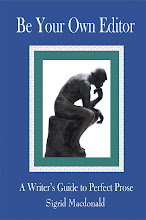
Learn more about word usage in my third book, Be Your Own Editor. When should you use between or among, further and farther, or complement and compliment? Find out in BYOE, available on Amazon.com in print and now a bestseller on Kindle. (http://tinyurl.com/4v249th)
Monday, April 4, 2011


Monday, March 28, 2011
Today's Writing Tip Is about Expanding Your Vocabulary
Indefatigable… pristine… eviscerate… antithetical… arduous… enervating. What do these words have in common? We don't see them that often.
An excellent way to improve your vocabulary and your writing is to read, read, and read some more. That way you'll learn new words and you will also see how certain things look in print; this is particularly good for writing dialogue and punctuation.
Choose things that interest you. If you don't like fiction, read nonfiction. If books take too much time, pick up a magazine or follow a blog dealing with a topic you really like. Or listen to a book on audio on your iPod or on CD in your car.
Don't turn it into homework, but do find a way to incorporate new words into your daily or weekly routine.
Learn more about word usage in my third book, Be Your Own Editor. When should you use between or among, further and farther, or complement and compliment? Find out in BYOE, available on Amazon.com in print and now a bestseller on Kindle. (http://tinyurl.com/4v249th)
An excellent way to improve your vocabulary and your writing is to read, read, and read some more. That way you'll learn new words and you will also see how certain things look in print; this is particularly good for writing dialogue and punctuation.
Choose things that interest you. If you don't like fiction, read nonfiction. If books take too much time, pick up a magazine or follow a blog dealing with a topic you really like. Or listen to a book on audio on your iPod or on CD in your car.
Don't turn it into homework, but do find a way to incorporate new words into your daily or weekly routine.
Learn more about word usage in my third book, Be Your Own Editor. When should you use between or among, further and farther, or complement and compliment? Find out in BYOE, available on Amazon.com in print and now a bestseller on Kindle. (http://tinyurl.com/4v249th)
Sunday, March 13, 2011
Today's Writing Tip Is on Comma Placement
Lynne Truss said it best with the title of her blockbuster hit Eats, Shoots & Leaves. That sentence can have two meanings depending on where we place the comma. If we omit the comma after the word Eats, we may think that someone eats bamboo shoots and takes off. But if we keep the comma, we know that a person ate, shot something and left. (Sarah Palin targeting moose in Alaska?)
Likewise with the following example: my aunt believed the babysitter and John and I were unfairly punished. What happens if I change the comma to this: My aunt believed the babysitter, and John and I were unfairly punished.
The first sentence could mean that the aunt thought that three people were unfairly punished -- the babysitter, John and the writer of the sentence. But it could also mean that the aunt believed a story that the babysitter relayed, thus, the aunt thought John and the writer were unfairly punished. The first sentence is ambiguous. If the writer wants to say that he and John were wrongly accused and reprimanded, the best way to write that would be: “My aunt believed the babysitter, and John and I were unfairly punished.”
Read more about punctuation in my third book, Be Your Own Editor, available in print (http://tinyurl.com/3xkoths) and now a bestseller on Kindle (http://tinyurl.com/3y3nuzb). Or get 20% off the regular price by writing directly to me at sigridmac at rogers.com.
*Please note that writing tips are nonpartisan and I already made fun of a Democrat last time!
Likewise with the following example: my aunt believed the babysitter and John and I were unfairly punished. What happens if I change the comma to this: My aunt believed the babysitter, and John and I were unfairly punished.
The first sentence could mean that the aunt thought that three people were unfairly punished -- the babysitter, John and the writer of the sentence. But it could also mean that the aunt believed a story that the babysitter relayed, thus, the aunt thought John and the writer were unfairly punished. The first sentence is ambiguous. If the writer wants to say that he and John were wrongly accused and reprimanded, the best way to write that would be: “My aunt believed the babysitter, and John and I were unfairly punished.”
Read more about punctuation in my third book, Be Your Own Editor, available in print (http://tinyurl.com/3xkoths) and now a bestseller on Kindle (http://tinyurl.com/3y3nuzb). Or get 20% off the regular price by writing directly to me at sigridmac at rogers.com.
*Please note that writing tips are nonpartisan and I already made fun of a Democrat last time!
Monday, February 28, 2011
Book promotion for authors

You've just published your masterpiece. Where do you go from here? How do you get dozens of quality reviews & Interviews? Find out from best-selling authors at Promotion À La Carte (PAC), the author's promotion service of choice. Voted #2 for 2010 at Preditors & Editors in the Promotion category.
Click here to view more details
Sunday, February 27, 2011
Today's Writing Tip Is on the Difference between Contrary and Contradiction
When should you use the word contrary and when should you use contradiction?
Contrary means argumentative. “You say yes, I say no. You say stop and I say go, go, go, oh no. You say goodbye and I say hello, hello, hello.” Hard to imagine someone being contrary to the Beatles, but there you go. When people are contrary, they disagree.
When people are contradictory, they may say one thing but do another. Their actions or words are inconsistent or incongruous. John Lennon was a man of contradictions; he advocated peace in his music, but wreaked havoc in his personal life, particularly in his first marriage. Contradictory is the adjective and contradiction is a noun. A contradiction is something that we find difficult to understand, like when Rev. Jesse Jackson ministered to Bill Clinton after Clinton confessed to having an affair, yet later the public discovered that Jackson, a married man, was the father of a love child (I promised I would give equal time to teasing Democrats in today's writing tip).
Learn more about word usage in my third book, Be Your Own Editor. When should you use between or among, further and farther, or complement and compliment? Find out in BYOE, available on Amazon.com in print and on Kindle. http://tinyurl.com/4v249th
Sigrid Macdonald is a book coach, the author of three books, and a manuscript editor.
Contrary means argumentative. “You say yes, I say no. You say stop and I say go, go, go, oh no. You say goodbye and I say hello, hello, hello.” Hard to imagine someone being contrary to the Beatles, but there you go. When people are contrary, they disagree.
When people are contradictory, they may say one thing but do another. Their actions or words are inconsistent or incongruous. John Lennon was a man of contradictions; he advocated peace in his music, but wreaked havoc in his personal life, particularly in his first marriage. Contradictory is the adjective and contradiction is a noun. A contradiction is something that we find difficult to understand, like when Rev. Jesse Jackson ministered to Bill Clinton after Clinton confessed to having an affair, yet later the public discovered that Jackson, a married man, was the father of a love child (I promised I would give equal time to teasing Democrats in today's writing tip).
Learn more about word usage in my third book, Be Your Own Editor. When should you use between or among, further and farther, or complement and compliment? Find out in BYOE, available on Amazon.com in print and on Kindle. http://tinyurl.com/4v249th
Sigrid Macdonald is a book coach, the author of three books, and a manuscript editor.
Saturday, February 12, 2011
This Is a Sort of Writing Tip
Lately I've been seeing the phrases "kind of" and "sort of" in print, and hearing them far too often on podcasts and radio. When is it appropriate to use these terms and when should we leave them at home?
If you have a task at work that is slightly difficult, you can say that it is kind of a pain. What you don't want to say is this: "I have a sort of project that needs to be finished by Friday." The first sentence has “kind of” modifying the word pain, which makes sense. The second sentence has the adjective modifying the word project, which doesn't make any sense, because we’re not going to have a "sort of” project. We either have a project or we don't!
Here's another one. “It's kind of important for me to show up at the party.” That sentence is fine. If I change it to this, it's grammatically incorrect: “It's important for me to kind of be at the party." You either show up or you don't. Kind of and sort of are filler words akin to “like…” (I was, like, so busy.) They seem to be the modern equivalent of saying “um” or “ah,” but you don't want to discard them altogether, because there are a number of instances where they are the best words of choice.
Sigrid Macdonald is a book coach, a manuscript editor, and the author of three books including Be Your Own Editor. BYOE is available on Amazon in soft cover (http://tinyurl.com/3xkoths) and on Kindle (http://tinyurl.com/3y3nuzb). Or get 20% off the regular price by writing directly to the author.
If you have a task at work that is slightly difficult, you can say that it is kind of a pain. What you don't want to say is this: "I have a sort of project that needs to be finished by Friday." The first sentence has “kind of” modifying the word pain, which makes sense. The second sentence has the adjective modifying the word project, which doesn't make any sense, because we’re not going to have a "sort of” project. We either have a project or we don't!
Here's another one. “It's kind of important for me to show up at the party.” That sentence is fine. If I change it to this, it's grammatically incorrect: “It's important for me to kind of be at the party." You either show up or you don't. Kind of and sort of are filler words akin to “like…” (I was, like, so busy.) They seem to be the modern equivalent of saying “um” or “ah,” but you don't want to discard them altogether, because there are a number of instances where they are the best words of choice.
Sigrid Macdonald is a book coach, a manuscript editor, and the author of three books including Be Your Own Editor. BYOE is available on Amazon in soft cover (http://tinyurl.com/3xkoths) and on Kindle (http://tinyurl.com/3y3nuzb). Or get 20% off the regular price by writing directly to the author.
Monday, January 31, 2011
Today's Writing Tip Is on Famous Versus Infamous
Oftentimes as an editor, I see people confuse the word infamous with famous, but they mean entirely different things.
Fame brings celebrity. It means that someone is well-known, and the connotation is generally, although not always, positive. Natalie Portman is a famous actress.
Infamous means that someone is well-known for an unsavory, contentious or salacious reason. It's synonymous with notorious -- no one has solved the mystery of the murder of the infamous Biggie Smalls.
Some people are famous and infamous -- Madonna, Alec Baldwin, Eminem, Mel Gibson… There is a long list of people who are easily recognizable, but also push other people's buttons because they’ve said or done something controversial. So, it's possible to be both famous and infamous, or just famous, or just infamous. (The Arizona shooter and the Unabomber are simply infamous. Not many people admire them, and they gained fame by doing something heinous.)
Learn more about word usage in my third book, Be Your Own Editor, a manual for students and writers of all ages and stages. Available on Amazon in print and in the Amazon Kindle store [http://tinyurl.com/4v249th].
Fame brings celebrity. It means that someone is well-known, and the connotation is generally, although not always, positive. Natalie Portman is a famous actress.
Infamous means that someone is well-known for an unsavory, contentious or salacious reason. It's synonymous with notorious -- no one has solved the mystery of the murder of the infamous Biggie Smalls.
Some people are famous and infamous -- Madonna, Alec Baldwin, Eminem, Mel Gibson… There is a long list of people who are easily recognizable, but also push other people's buttons because they’ve said or done something controversial. So, it's possible to be both famous and infamous, or just famous, or just infamous. (The Arizona shooter and the Unabomber are simply infamous. Not many people admire them, and they gained fame by doing something heinous.)
Learn more about word usage in my third book, Be Your Own Editor, a manual for students and writers of all ages and stages. Available on Amazon in print and in the Amazon Kindle store [http://tinyurl.com/4v249th].
Subscribe to:
Posts (Atom)