Twenty years ago, the concept of multitasking was rare. Most people worked at one task at a time. Writers may have been different; perhaps they turned on music in the background when they wrote to help their creative juices flow. But they weren't likely to be watching the tickertape on the news, texting from their phones, and checking other open windows on their computers while they were writing.
Many studies, especially those conducted with the younger generation, have found that people who multitask believe that they are doing just as well, if not better, than if they had focused on one task at a time, but the hard-core proof indicates otherwise. And who needs a study to reaffirm what we already know from common sense? Doing one thing at a time yields better results.
This is probably more true for rewriting and editing one's work than writing. I often find that background music helps me to write, but I turn it off right away when I'm revising and polishing because using my creative mind is very different from using my meticulous inner critic.
Ask yourself how much of a multitasker you are. And see if it makes a difference to your writing and editing your own work if you buckle down and do one thing at a time. Easier said than done, I know, but well worth the experiment.
Sigrid Mac
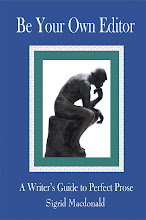
Author of Be Your Own Editor
Thursday, April 19, 2012


Monday, March 26, 2012
Today's Writing Tip Is What We Can Learn from Mad Men
Last night, I eagerly tuned into Mad Men, after a seventeen-month hiatus. Season five started with a bang and I was thoroughly satisfied, as usual. But this time I heard an awkward sentence that I wanted to use as an example here.
Happy writing and Mad Men viewing.
Peggy, the ambitious secretary turned copywriter, said, "I wish I would have known that." (I confess that I can't recall the context, so that should encourage you to rent the DVD.) This is a no-no.
Here's how she could have done it differently: "I wish I had known that." Or "I would have liked to have known that." I prefer the simpler version, so I would go with option A: "I wish I had known."
There is never a good time to use the phrase "wish I would have." At least, I can't think of one. If you can, let me know. But there are lots of times that we can say, "wish I had" or "I wish I would." It's fine to say, "I wish I would exercise more," or "I wish I had known that Jon Hamm planned to take his shirt off during the season premiere, so I could've taped it for all of eternity." What you want to avoid is mixing the words "wish" with "would have."
Happy writing and Mad Men viewing.
Sigrid Mac
Saturday, March 24, 2012
Announcing the Release of My New Novel, Straight and Narrow
New Mystery by Sigrid Macdonald, Straight and Narrow
Several years ago, OIW member Sigrid Macdonald published a book called D’Amour Road, which was loosely based around the true-life disappearance of an acquaintance of hers in Ottawa. She has since discontinued that book and rewritten large parts of it. The final outcome is Straight and Narrow, a darkly witty mystery with complex subplots.
Right before her fortieth birthday, Lisa Campana goes missing. Her best friend, Tara, is devastated and bewildered. Has Lisa broken her sobriety or has she gone into hiding because she is afraid to tell her partner, Ryan, that she's pregnant and he may not be the father? Worse, Ryan has a history of battery. Could he have harmed her? Take a roller coaster ride with Tara Richards as she falls headfirst into a comical midlife crisis while dealing with the grave situation of searching for her missing friend.
Amazon Kindle: http://tinyurl.com/7pzqvla
Thursday, March 8, 2012
Be Your Own Editor Is Free on Kindle for the Next Five Days!
Be Your Own Editor, a guide for writers and students, will be free on Amazon Kindle from March 8 to March 12. If you're not sure how to develop characters, create realistic dialogue, or develop background settings for fiction or how to structure and write clearly for nonfiction, BYOE will guide you step-by-step. The book also discusses how to write smashing essays as well as e-mail etiquette.
If you like the book, it would be great if you could write a short review.
Download your free copy here: http://tinyurl.com/7cp8evh
Wednesday, March 7, 2012
Today's Writing Tip Is on Passive Sentences
Generally, a passive sentence fails to identify who performed an action. A good example would be, "The bank was robbed." We don't know who robbed the bank. Sometimes that's fine because the person who committed the robbery has not yet been apprehended. But if we do know who stole the money – and we are not in cahoots with him – we may want to phrase that sentence more dynamically: "Jack robbed the bank."
A less recognizable form of the passive sentence is when we simply make a clumsy sentence construction. This morning I was listening to CNN talk about the results of Super Tuesday. One of the announcers referred to "The counties that were won by Santorum" and "The counties that were won by Romney." Why not just say, "The counties that Santorum won" or "The counties that Romney won"?
Also, the word "that" is losing popularity; many publishers and editors recommend deleting it whenever you can. So the cleanest way to write the above sentences would be, "The counties Santorum (or Romney) won..." That not only removes any passivity from the sentence, but it also reduces wordiness.
Sigrid Macdonald is a manuscript editor and the author of three books, including Be Your Own Editor, a category bestseller on Amazon.
Sunday, January 29, 2012
Today's Writing Tip Is on Convince and Persuade
The words convince and persuade may sound so similar that we think they're interchangeable, but they're not. They are not exact synonyms, despite what dictionary.com says!
According to The Chicago Manual of Style, persuade is related to actions and often takes the verb “to” before it. If I want to go to a drama movie, but you only like comedies, I have to persuade you to go with me.
Convince is related to ideas. Let's say that you don't know who to support in the Republican primary, so you watch the debates. You come away convinced that none of the contenders represents you. Note that convince is not preceded by the verb “to.”
Check out more grammar and writing tips in my book Be Your Own Editor.
Subscribe to:
Posts (Atom)