Pages

Tuesday, August 14, 2012

Today's Writing Tip Is From Worse to Worse

I'm surprised at how often I see the phrase "from worse to worse" in print. It doesn't make any sense. It's a lot like the term "I could care less." Neither one says what you want them to say.

Let's reason this out. If I am number 10 in line in the grocery store and I move forward one spot, I become number nine. If I move back one spot, I become number 11. In either case, there is a sense of motion and movement. Something changes.

If I go from worse to worse, nothing much changes. I am still number 10 in line at the grocery store – or maybe I'm 10 1/2. I have to go from worse to worst in order to see a significant change. An easy way to remember this one is to think of the opening line in A Tale of Two Cities: "It was the best of times, it was the worst of times." Thus, you want to go from worse to worst. Although of course, you don't really. That is the outcome that most of us are hoping to avoid.

As a postscript, I will add that the correct way of saying I don't give a damn is "I couldn’t care less," because if you could care less it means that you already care. If you couldn't care less, you care so little that your interest in the matter is currently negligible. Thus, it couldn’t become any more unimportant to you; hence, you couldn't care less.

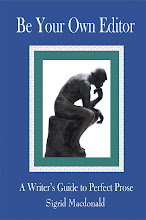
Sigrid Macdonald is the author of three books, including Be Your Own Editor http://tinyurl.com/7wnk5se and two erotic short stories, which she wrote under the pen name Tiffanie Good. Silver Publishing just released "The Pink Triangle," a tale of friendship, lust, and betrayal. You can view her story here: http://tinyurl.com/6v65rgr 

Tuesday, July 24, 2012

Today's Writing Tip Is on Matching Terms

Quite a bit has been written about misplaced modifiers like "Sheila drove her car into the kitchen in a long dress." We know that sentence needs to be rearranged so that no one mistakenly envisions the kitchen wearing a long dress.

Something similar to a misplaced modifier, but slightly different, is when we match up the wrong nouns and verbs.

"Tommy was sitting at the table munching on his milk and cookies." I can just hear him biting into the milk. Hmmm. That's not going to work! You need to switch it around. "Tommy was sitting at the table munching on his cookies and milk." I find that adequate, but some grammar Nazis might want to rewrite the last phrase to make it even more accurate: "Tommy was sitting at the table munching on his cookies and guzzling his milk." Because then when you look at it, he's not going to be munching on milk. Unless he's a pretty weird kid.

Sigrid Macdonald is the author of three books, including Be Your Own Editor (http://tinyurl.com/7wnk5se) and two erotic short stories, which she wrote under the pen name Tiffanie Good. Silver Publishing just released "The Pink Triangle," a tale of friendship, lust, and betrayal. You can view her story here: http://tinyurl.com/6v65rgr 


Wednesday, July 18, 2012

Today's Writing Tip Is on Figurative Versus Literally

You'd think that this would be an easy one, but many people misuse the word literally. Literally means in reality or actually. If something happens literally, it really occurs. Figuratively refers to imagination or something that is hypothetical. When something happens figuratively, it doesn't really occur.

"She barked like a dog, literally." Right or wrong? Wrong. Unless we're talking about a German Shepherd, or a little schnauzer, a human woman can't bark like a dog literally. She can bark like a dog metaphorically or figuratively speaking, but we wouldn't phrase it that way. We would probably just say, "She barked like a dog!"

So, what's the right way to use the term literally? "Forty-five people stood in line at the Dairy Queen on a hot summer night, but the DQ literally only had enough ice cream to feed twenty-nine of them." As long as it took place and it makes sense in the real world, you can say literally.

Figuratively encompasses different forms of speech like metaphors and similies, when we compare something to something it's not. The barking dog is a good example of a simile, which is a form of figurative speech that usually uses the term "like" or "as." "He looked like a ghost" and "he swam like a fish" are both similies.

Sigrid Macdonald is the author of three books, including Be Your Own Editor http://tinyurl.com/7wnk5se and two erotic short stories, which she wrote under the pen name Tiffanie Good. Silver Publishing just released "The Pink Triangle," a tale of friendship, lust, and betrayal. You can view her story here: http://tinyurl.com/6v65rgr 


Saturday, July 7, 2012

Virtual Author Assistant

As the FIRST and ONLY Certified Professional Virtual Author Assistant in the Caribbean, Corine is proud to be able to offer authors anywhere in the world, the unique and growing services that can save you, the author, a lot of stress and rework. Her services are not limited to authors alone. Coaches, small business persons, individuals and large corporations can utilize her services.

Trained also in online virtual events and online book marketing, Corine is in the unique position to help you take advantage of the technologies that are available to get you where you want to go. For more details visit www.helpdeskja.com/services

Corine’s Area of Expertise:

  • eBooks and e-Publishing- formatting and publishing to Kindle and Smashwords
  • Online Book Marketing- Media Kit, Book Awards and Competitions,Guest Blogging, Virtual Book/Blog Tour, Set-up of Author’s Platform (blog/website), Amazon Best Seller Campaigns
  • Coordination and assistance with Manuscript Creation-Book proposal
  • Research Target Audience, Fact Checking, Permissions
  • Virtual Events-webinars, bookinars, teleseminars, book study groups
  • Re-purposing of Video and Audio- Book Trailers, articles tips, eBooks, press releases, workbooks, CD and DVD

Feel free to reach out to Corine at corine@helpdeskja.com or visit her website at www.helpdeskja.com or social networks:

Like us on Facebook: http://www.facebook.com/helpdeskja
Tweet @authorasst
LinkedIn: http://jm.linkedin.com/in/clafont


Monday, June 11, 2012

Today's Writing Tip Is about Creating Conflict

Recently, I wrote a book review on Fifty Shades of Grey, the new runaway bestseller about Anastasia Steele, a naïve young woman who falls for Christian Grey, a man who can only derive pleasure from a dominant/submissive relationship. Christian is perfect in every respect except sexually; he is damaged and can only be aroused by inflicting pain. This is not exactly our dream man, but readers love the book. Why? Aside from some very steamy sex scenes, Anastasia is confused, bewildered, and ambivalent about her relationship with Christian. This creates good reading.

It makes her a three-dimensional character and provides suspense; we don't know if she will stay with Christian. It makes her sympathetic. We feel for her dilemma. She's crazy about him, but he's just plain old crazy (unless you’re a fan of sadomasochism).
Thus, in real life we may prefer partners who are relatively drama free, but this would make for very boring literature. When you are developing your characters, make sure they have enough conflict, both internally, within themselves, and externally with other people.

Sigrid Macdonald is the author of three books, including Be Your Own Editor, and two erotic short stories, which she wrote under the pen name Tiffanie Good. Silver Publishing just released "The Pink Triangle," a tale of friendship, lust, and betrayal. You can view her story here: http://tinyurl.com/6v65rgr  
Monday, June 4, 2012

Today's Writing Tip Is "Do You Mind?"

I'm always amused when I ask someone if they mind if I do something, and they say yes when they really mean to say no. Here's an example:

Me: Do you mind if I borrow your printer?
Other person: Sure, go ahead.

Wrong answer! The question was, do you mind?, so the answer should be no. In an ideal world, this is the way people would answer:

Me: Do you mind if I borrow your printer?
Other person: What's wrong with your printer?
Me: Well, I just got a new laser printer, and the paper jammed, and when I went to replace the toner...
Other person: No, I don't mind. Go ahead.

Saturday, May 5, 2012

Today's Writing Tip Is on Using Your Spellcheck

Previously I've written about the drawbacks of the spellcheck device in Word, Yahoo or Gmail, or Outlook Express. There are many disadvantages to relying on a spellcheck, starting with the fact that it doesn't always recognize homonyms, and it will frequently miss a typo if the word is spelled correctly. For example, the grammatically incorrect sentence, "I went to give him a huge" was not flagged by my Outlook or in Word.

However, despite all its frailties, it's critical to use a spellcheck for e-mails, articles, and, in particular, manuscripts. Why wouldn't you take advantage of that? It's like doing complicated math in your head instead of pushing a few buttons on a calculator. I may know how to do a square root, but if a machine can do it for me and I know that it will be accurate, I would be foolish not to take advantage of the wonders of the 21st century.

The spellcheck is nothing like a calculator because it doesn’t have a 100% accuracy rate if you pump in all the right numbers like a calculator. But spellcheck will recognize a large number of misspelled words and flag all kinds of grammatical problems.

If you are writing a manuscript and submitting it to an editor, the editor determines his or her price estimate for your project based on how many hours the project will take. And if it's not spellchecked, it will take a lot longer to do than a manuscript that has been checked. Deliver a clean product. Enable the automatic spell-checking on your e-mail program and always push F7 when you finish an article or manuscript. It really makes a difference.

Sigrid Macdonald
Author of Be Your Own Editor

Free Search Engine Optimization