Pages

Thursday, April 25, 2013

Today's Writing Tip Is about Clarity

Know What I Mean?

You know what you want to say but sometimes it’s hard to express. Try to imagine your reader. Could anything you’ve written be ambiguous? Could it be confusing? Don’t assume that the reader knows what you are thinking. Step back and fill in certain details or clarify to be as precise as possible.

Take this sentence: “That ended her short life in Shadow Lakes.” What ended her life there? Did she die or simply move? Or did she stay but she never had a decent quality of life afterward? Think like a reporter and ask yourself all the W’s: who, where, what and why (and, of course, the non-W, how). Once you’re clear about those, convey them to the reader.

“Marrying Stephen ended her short life in Shadow Lakes because they moved into the city right after their honeymoon.”

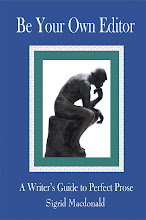
Sigrid Macdonald is an editor and the author of three books. This is an excerpt from her last book, Be Your Own Editor, available on Amazon: http://tinyurl.com/c3az54r

Tuesday, April 9, 2013

Today's Writing Tip Is When to Use Can or Could

It's easy to determine when to use the word can and when to use could. Can indicates ability. I can type a letter. I can run 10 miles. I can write a fan letter to Jon Hamm, although he probably won't answer. Can denotes certainty. Could denotes uncertainty.

I could go to visit my sick neighbor if I don't have to work on Thursday night. My neighbor could die from pneumonia if her immune system is not strong. My son' s car could last another five years if he's lucky. The most significant word in the last three sentences is "if" because the first part of every sentence depends on another factor. It could happen, but maybe it won't. Whereas when we use can, something will generally happen or at least the person has the ability to make it happen.

Parents used to teach children table manners by differentiating between the words can and may. A child would say, "Can I go now?" after dessert, and the parent would retort, "May I go." Because clearly the child can go by simply getting up and leaving the table. Using may is a way of asking permission.

Sigrid Macdonald is the author of three books and two short stories, and is also a manuscript editor. Find her at http://sigridmacdonald.blogspot.com/.


Saturday, March 30, 2013

Today's Writing Tip Is Question Marks In the Middle of a Sentence

Punctuating question marks in the middle of a sentence confuses the best of us. Our instinct is often to capitalize the word that follows the question mark, but usually that's wrong. Here's an example:

When I asked my teacher, Mr. Cotton, "What is the purpose of life?" this is the answer I received.

Note two things about that sentence. One, the word that proceeds the question and the question mark is lowercased. That's because the phrase "What is the purpose of life?" is still part of a larger sentence, even though it is a complete sentence and can stand on its own normally, but in this instance it is only half of the sentence. "This is the answer I received" is the other half and we need it to make our point. Two, there is no comma after the question mark. A version of our example which includes the comma is wrong, e.g., When I asked my teacher, Mr. Cotton, "What is the purpose of life?," this is the answer I received.

Fortunately, your spellcheck will probably pick up the second issue and flag it as a problem; however, spellcheck may incorrectly tell you that you want to capitalize any word after a question mark. Don't do it automatically; do so only if it is not part of a larger sentence and that includes dialogue. ("Is the purpose of life to love and be loved?" she asked. No caps for the pronoun and no comma after the question mark.)

Sigrid Macdonald is an author and an editor. You can find her at http://sigridmacdonald.blogspot.com/   

Wednesday, March 13, 2013

Today's Writing Tip Is When to Use "Like" and When to Use "As If"

Like and As If

Recently, my mother said to me, “I feel like a bowl of soup.” I replied, “You don’t look like a bowl of soup” and she grimaced. Ordinarily the family grammarian, my mother would have been better off saying, “I feel like having a bowl of soup” unless indeed she felt wet, warm, and slushy.

If you like ice cream, if someone is running like a bear, if it feels like 120° in the shade, that’s the appropriate way to write it. But if you write, “I feel like going home,” that’s not optimal grammar. It’s better to say, “I want to go home.” And instead of writing, “I felt like he didn’t respect me” write, “I felt as though…” or “I felt as if he didn’t respect me” because the first phrase is slang, but the second and third are not.

However, if you want to use that line when you are composing dialogue that’s fine because we know you’re simulating authentic conversation. That works especially well if you’re quoting a teenager, who won't necessarily be speaking in full sentences or using proper grammar.

This is unrelated to the word “like” that frequently pops up in slang, especially for those under the age of twenty-five or thirty. “I went to the movie and it was, like, so sweet!” It’s all right to use that sentence in dialogue but the grammar police will be all over your case if you use it in any other context.

This is an excerpt from the book Be Your Own Editor, by Sigrid Macdonald. Visit her at: http://sigridmacdonald.blogspot.com/  

Sunday, March 3, 2013

Multitasking – Does It Help or Hinder Writing?


I used to play music when I wrote letters, short stories, and articles. Then when I became an editor, and started proofreading or evaluating manuscripts, I continued this practice. Big mistake. When it comes to editing, I definitely need to focus on one thing at a time. Now I turn off the TV, ignore incoming text messages, and close my Facebook page in my browser; the only windows I leave open are dictionary.com and a search engine if it's related to what I'm researching.

Some people feel more creative writing with music playing in the background, and aren't distracted by answering the occasional text or e-mail. That's fine, but know yourself and try it both ways. If you've been accustomed to doing three or four things at one time while you write, try eliminating them all and just write. Conversely, if you sit in total silence, experiment with playing something soothing, stimulating, or edgy and see if it improves your story. But definitely downplay your distractions when you're proofreading your work.

Sigrid Macdonald is an editor and the author of three books, including Be Your Own Editor. You can find her at http://sigridmacdonald.blogspot.com/


Wednesday, February 13, 2013

Today's Writing Tip Is on Critiquing Someone Else's Work

At some point in our writing careers, we may join a writers' group or be asked to provide constructive criticism to a fellow writer. This is not always as easy as it seems. Some people have thick skin and when they say that they want us to be bold and to deconstruct their work, they mean it. Other people may be very sensitive. Some may want a thorough evaluation and others may only want a brief report akin to a book review. What to do?

First, be tactful. Telling someone that the characters in their novel sound like robots is potentially hurtful. Make an honest list of what you think about the material and then go back and revise it as carefully as possible, taking your friend's feelings into account. Second, be honest. It won't help anyone to tell them that their book is on its way to being an Amazon bestseller if it's an inferior and poorly-written piece of work. Third, be helpful and individualize your response. For example, if you think the whole book should be rewritten from start to finish but you know perfectly well that the writer has neither the ability nor the intention to do so, don't provide that kind of feedback. It won't be useful. Make sure that whatever you say is kind and specific so that the writer knows how to implement changes. Instead of saying, "That scene in part two didn't work for me at all," tell the author why and if at all possible, suggest a way to improve it.

Last, talk about the writing instead of the writer so that the person doesn’t feel attacked. In the end, your writer friends will love you for your diplomacy and will benefit by your carefully chosen advice.

Sigrid Macdonald is the author of three books and a manuscript editor. You can find her at http://sigridmacdonald.blogspot.com/  


Friday, February 1, 2013

Today's Writing Tip Is How to Spell Internet

It comes as a surprise to some people that the word Internet is always capitalized. Ditto for the abbreviation "Net." Why is this?

The Internet is like a place. It is a large computer network that connects computers all over the world. In grammatical terms, it is treated as a proper noun. However, as Wikipedia points out, when we refer to the World Wide Web and the Internet, we want to capitalize that, but if we are referring to smaller internet channels, we don't necessarily have to capitalize them.

By and large, when people write about the Internet, they are referring to the big picture, hence the need for caps. One way to make sure that you spell this right is to perform a spellcheck at the end of your e-mail, article, or manuscript. It will pick that error up right away.

Sigrid Macdonald is the author of three books, including Be Your Own Editor http://tinyurl.com/7wnk5se and two erotic short stories, which she wrote under the pen name Tiffanie Good. Silver Publishing just released "The Pink Triangle," a tale of friendship, lust, and betrayal. You can view her story here: http://tinyurl.com/6v65rgr 


Free Search Engine Optimization