Pages

Wednesday, January 22, 2014

Today's Writing Tip Is on What With

Lately I've been running into a number of sentences that use the term "what with." For example, "I've been super busy this semester what with taking care of the kids and doing my online accounting course." Or "I can't afford to take the family to a movie what with the high cost of admission and the price of popcorn and sodas. Better to stay home and watch a DVD, especially on these cold nights."

I don't see the point of adding the word "what" when the sentences will work perfectly well without it and will be much cleaner. For example, "I've been super busy this semester with taking care of the kids and doing my online accounting course." In that instance, you could also remove the word "with," making this sentence read, "I've been super busy this semester taking care of the kids and doing my online accounting course." But the second sentence reads better with the word "with." "I can't afford to take the family to a movie with the high cost of admission…"

Whenever you can make a sentence more concise and less wordy, do it.

Sigrid Macdonald is a manuscript editor and the author of three books. Find her at http://sigridmacdonald.blogspot.com/  

Tuesday, January 7, 2014

Today's Writing Tip Is on Women Criminals

The other day I heard someone talking about women criminals. The term is awkward for two reasons: first, it's wrong because we want to use the adjective female instead of the word women. Second, it implies, however subtly, that criminals are men.

This is not a matter of political correctness but rather of accuracy. The same could be said for Jewish dentists or teenage mothers. Sometimes clarifying one's ethnicity or age is crucial to our story, but other times it's irrelevant and can seem patronizing, sexist, or racist. Female driver is a good one since it is often used in the pejorative.

Before you specify someone's race, gender, age, or disability, ask yourself if it's really necessary for the reader to know that the grocer is Indian or the postal worker (can't say postman anymore!) is Asian. If it's essential information, you want to provide it, but use caution when employing these potentially hot button terms.

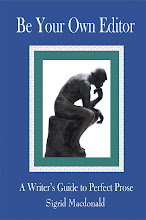
Sigrid Macdonald is an editor and the author of three books, including Be Your Own Editor. Find her at http://sigridmacdonald.blogspot.com/  


Tuesday, December 24, 2013

Today's Writing Tip Is on Double Negatives

Normally we don't want to use a double negative, meaning we don't want two words in a sentence that indicate that we don't want to do something. For example, "I don't want nothing at the store" reads much better as "I don't want anything at the store." But sometimes there are exceptions.

Often written dialogue sounds more realistic with double negatives, especially if you are quoting people who are deliberately misspeaking such as teenagers who know better but are trying to sound cool, or people who are accidentally misspeaking such as those with English as a second language.

The other time that I like double negatives for writers is for emphasis. I was listening to a song by Boyzone yesterday (yes, I know, a boy band, slightly higher on the totem pole than Backstreet Boys, whom I also like, for the record. So, shoot me.) and they sang the following line: "I'll never not need you." Those words kept going around and around in my head, not just because I'm a writer and an editor and double negatives pop out at me like a caterpillar crawling through a Caesar salad but also because of the impact the line made. Never not need you. It sounded so romantic, much more so than "I'll always need you."

So, double negatives aren't always taboo, but in general they are something we want to avoid. The trick about using them is to know the rule first – that they are not grammatically correct – and then feel free to break that rule if you have good reason.


Monday, December 9, 2013

Today's Writing Tip Is on Slang

Sometimes we're not sure how to spell slang words. Is it gonna and wanna, goo’ night, yer mother, and hook up? What about profanity? God damn right or goddamn right? Can you spell the word boys as boyz if you want to give it a hip-hop feel? Should we just guess and standardize our diction using a style sheet? Urban dictionary to the rescue!

There are a number of excellent slang dictionaries online that tell us the proper way to spell phat (no, I'm not talking about that feeling of despair when you stand on the scale), innit (British), and other words that may not appear in traditional dictionaries. And like Merriam-Webster, dictionary.com, or Collins Gage, these dictionaries are individualized for the US, Canada, and the UK.

Actually, it can be fun to just browse these dictionaries to find new words, but they're also very useful to have in our toolkit when we come up against slang or swear words that we know how to say but we're not completely sure how to spell.

Sigrid Macdonald is an editor and the author of three books. Her last book, Be Your Own Editor, is available on Amazon: http://tinyurl.com/c3az54r and you can read more about her editing services at http://sigridmacdonald.blogspot.com/  

Monday, November 18, 2013

Today's Writing Tip Is: Do Authors Need a Social Media Presence?

Whether a writer self-publishes or publishes through a traditional company, much of the marketing nowadays falls on the writer's shoulders. For years publicists and advertising specialists have encouraged authors to develop a strong social media presence: Facebook, Twitter, MySpace, LinkedIn, and now Instagram have been recommended as essential tools for writers to promote their material. But are these avenues essential? More importantly, are they effective and lucrative? It depends.

Personally, I have spent hundreds if not thousands of hours on Facebook and Twitter. Out of the 10,000 books I've sold, I probably sold about 30 through Facebook and I've received two or three clients at most for my editing services on LinkedIn and Twitter combined. I have also paid hundreds of dollars to consultants to optimize my Facebook page, to no avail in terms of selling books. I have, however, reconnected with numerous precious people from high school and college, so I would never say Facebook has been a complete waste. But it has not been effective for me in terms of book sales. Ditto for most of the dozens of authors I know.

Because I'm a scientist at heart, I know that my friends and I are just anecdotal evidence. Our experiences don't constitute proof that social media is irrelevant for authors, but if you want to devote hours to Facebook for the sole purpose of selling books, make sure to create a fan page for yourself and update it regularly, preferably every day. The fan page has to be separate from your regular page and you should attempt to build a wide base there. Post excerpts from your book, your book cover, info about book signings, and hold contests. Give away free electronic copies of your book and occasionally a print copy. Consider paying Facebook for advertising. And make yourself accessible. The worst thing to do is to create a fan page and then disappear and only update once a month. No one will read it in that case.

Twitter and LinkedIn are different stories. LinkedIn is much more business oriented and good for connections, but Twitter moves fast. If you follow other authors in your genre, they are likely to follow you back but will not necessarily buy your books. Set aside a certain amount of time per week for promoting your book on these venues – but by all means don't be aggressive. There is nothing people dislike more than people who ramble and obsess on a newsfeed begging them to buy their books. Then do an inventory after a few months to see if your presence there has made any difference in book sales. If not, reconsider the value of social media for book promotion and just use it for fun.

Sigrid Macdonald is an editor and the author of three books. Her last book, Be Your Own Editor, is available on Amazon: http://tinyurl.com/c3az54r


Thursday, October 24, 2013

Today's Writing Tip Is on Castles Made of Sand

The other day I was in the car listening to Jimi Hendrix and I nearly drove off the road when I heard him sing, "And so castles made of sand melts into the sea eventually." Okay, we have to give this rock God a major pass for making some of the best music in the world when he was out of his mind on too much acid and writing before the invention of the spellchecker. But can we gently, and with love, deconstruct that sentence and try to determine the origin of Jimi's mistake?

Hendrix probably thought that sand melts and he forgot that the beginning of his sentence, and the direct subject, was castles, not sand. Usually we can tell by the way things sound when our subject and verb are not in agreement, but if you tend to go into your own purple haze, where you might forget what’s supposed to match, keep in mind that several extraneous words or clauses may intervene between your primary subject and your verb. And go back to take the extra time to make sure that your subjects and verbs line up.

Of course, you could always try writing when you're high to increase your creativity, but proofreading when you're stone cold sober!

Sigrid Macdonald is an editor and the author of three books, including Be Your Own Editor, available on Amazon: http://tinyurl.com/c3az54r


Monday, October 7, 2013

Today's Writing Tip Is on Efficiency

One way I have found to be efficient in business and my personal life is to take the thing that I want to do least and do it first. Every morning when I get up, I assess what I have to do for work and what I have to do to keep my fabulous recreational life going. And I decide which tasks are fun and easy and which ones are a total bore or difficult. I take the latter and knock them off right away. That means that by 10 a.m. or 11 o'clock, my day is filled with things I want to do because I've already completed the ones I didn't want to do.

This works for writing as well. There are always some things we enjoy more about writing than others. This varies from person to person. Let's say you're writing a novel and you adore writing the action scenes, but you hate fact checking. As soon as you tackle your work, devote a specific period of time to fact checking. It might be twenty minutes or however long you think you can tolerate. Then get back to writing your action scenes. You'll feel so much better knowing that the task you dreaded is already out of the way.

Sigrid Macdonald is an editor and the author of three books. Her last book, Be Your Own Editor, is available on Amazon: http://tinyurl.com/c3az54r

 

Free Search Engine Optimization