I live in a small residential community that is part of a large metropolis. My neighborhood will be undergoing extensive construction to build a light rail system. I had questions about this so I wrote to my local town councilman. Because I use a voice dictation program, when I dictated my letter, instead of saying Councillor Chiarelli, it said Counselor Chiarelli. I noticed this while I was dictating, but I forgot about it by the end of the letter, and sent it with the wrong title.
What are some of the most embarrassing typos that you've made? My voice program will make some real doozies that don't even resemble typos because they are related to voice, rather than keyboard errors, so I really have to watch homonyms (e.g., when I said, "dictation" above, my Dragon NaturallySpeaking program typed the words "patient program.") I could use a laugh today. Tell me and my readers about your funniest typos. Post them here on my blog.
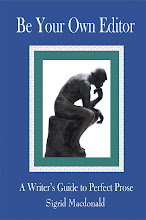
Sigrid Macdonald is a book coach, a manuscript evaluator, and the author of three books, including Be Your Own Editor, now available on Amazon.com: http://tinyurl.com/2a3zx6t (Paperback) and http://tinyurl.com/2blyqng (Kindle).
Monday, September 20, 2010


Monday, September 13, 2010
Today's Writing Tip Is on Obscure References
Last week, I finished reading Bright-Sided by Barbara Ehrenreich. It was a wonderful critique of the down side of too much positive thinking, and how this can be used to blame people for making themselves ill, and even contribute to economic decline, if leaders in power don't want to hear any "bad news."
I wrote Ehrenreich a letter and entitled it "The Bright Side of the Road." I wanted to grab her attention by using a song title by Van Morrison. Right after I pressed send -- naturally! -- it occurred to me that maybe she wasn't a fan of Van's. If so, she could've missed my reference and thought I was misquoting the title of her book.
Now I will be more careful with obscure references. What may seem obvious to me may be a mystery to someone else. The goal of writing is not to be clever, but to be clear in communicating.
This week I'm giving away three free e-copies of Be Your Own Editor to the first people who can each list five well-known dystopian books (not movies). If the first poster mentions The Handmaid's Tale by Margaret Atwood, the second poster cannot repeat that title. Post your answers on my blog at http://beyourowneditor.blogspot.com and gear up for the next quiz where the winner will win a free paperback copy of the book!
Sigrid Macdonald is an editor, a manuscript evaluator, and the author of three books, including Be Your Own Editor. Find it on Amazon in paperback for $12.92 (http://tinyurl.com/2a3zx6t) or on Kindle for $3.79 (http://tinyurl.com/2blyqng).
I wrote Ehrenreich a letter and entitled it "The Bright Side of the Road." I wanted to grab her attention by using a song title by Van Morrison. Right after I pressed send -- naturally! -- it occurred to me that maybe she wasn't a fan of Van's. If so, she could've missed my reference and thought I was misquoting the title of her book.
Now I will be more careful with obscure references. What may seem obvious to me may be a mystery to someone else. The goal of writing is not to be clever, but to be clear in communicating.
This week I'm giving away three free e-copies of Be Your Own Editor to the first people who can each list five well-known dystopian books (not movies). If the first poster mentions The Handmaid's Tale by Margaret Atwood, the second poster cannot repeat that title. Post your answers on my blog at http://beyourowneditor.blogspot.com and gear up for the next quiz where the winner will win a free paperback copy of the book!
Sigrid Macdonald is an editor, a manuscript evaluator, and the author of three books, including Be Your Own Editor. Find it on Amazon in paperback for $12.92 (http://tinyurl.com/2a3zx6t) or on Kindle for $3.79 (http://tinyurl.com/2blyqng).
Monday, August 16, 2010
I Could Care Less about Today's Writing Tip!
Some people have trouble determining when to use the phrase, "I could care less," and when to say, "I couldn't care less." Here's an illustration:
A local radio show is about to go off the air, and Bill is upset. He loves this program, but his friend Bob can't stand it. Bob has no interest in talk radio, therefore, he could not care less about the show's demise. Saying that Bob could care less would mean that he would have to care somewhat to begin with, but he doesn't care at all.
There may be rare instances when you want to say "could care less," but it can only be used when someone already cares. Most of the time this expression is used to indicate indifference, so you want to use, "I couldn't care less."
John Cleese says it best: http://www.youtube.com/watch?v=uCUsPnKD1gk
Sigrid Macdonald is a book coach, a manuscript evaluator, and the author of three books, including Be Your Own Editor, now available on Amazon.com: http://tinyurl.com/2a3zx6t (Paperback) and on sale at http://tinyurl.com/2blyqng (Kindle).
A local radio show is about to go off the air, and Bill is upset. He loves this program, but his friend Bob can't stand it. Bob has no interest in talk radio, therefore, he could not care less about the show's demise. Saying that Bob could care less would mean that he would have to care somewhat to begin with, but he doesn't care at all.
There may be rare instances when you want to say "could care less," but it can only be used when someone already cares. Most of the time this expression is used to indicate indifference, so you want to use, "I couldn't care less."
John Cleese says it best: http://www.youtube.com/watch?v=uCUsPnKD1gk
Sigrid Macdonald is a book coach, a manuscript evaluator, and the author of three books, including Be Your Own Editor, now available on Amazon.com: http://tinyurl.com/2a3zx6t (Paperback) and on sale at http://tinyurl.com/2blyqng (Kindle).
Thursday, August 5, 2010
RSVP, Please -- Today's Writing Tip Is on Redundancy
How many times do you run across phrases like this?
David just sent me a text from his cell phone.
I have to be there at 10 AM in the morning.
He was all alone by himself.
The rugged kayak lover grew up in a tiny little town.
Stop! There's no need to repeat yourself. We know that a text message is not being sent from a toaster, and that 10 AM will always be morning. When you're writing, it's good to be creative and allow your juices to flow. Get everything down. But when you're editing, streamline. Cut everything that's unnecessary. It will make for a much cleaner sentence... And there is no need to add "please" to RSVP because SVP stands for s'il vous plaît, the French term for please.
Sigrid Macdonald is a book coach, an editor, and the author of three books, including the newly released Be Your Own Editor, available on Lulu or on Amazon in paperback, and on Kindle.
http://tinyurl.com/2a3zx6t (Paperback)
http://tinyurl.com/2blyqng (Kindle)
David just sent me a text from his cell phone.
I have to be there at 10 AM in the morning.
He was all alone by himself.
The rugged kayak lover grew up in a tiny little town.
Stop! There's no need to repeat yourself. We know that a text message is not being sent from a toaster, and that 10 AM will always be morning. When you're writing, it's good to be creative and allow your juices to flow. Get everything down. But when you're editing, streamline. Cut everything that's unnecessary. It will make for a much cleaner sentence... And there is no need to add "please" to RSVP because SVP stands for s'il vous plaît, the French term for please.
Sigrid Macdonald is a book coach, an editor, and the author of three books, including the newly released Be Your Own Editor, available on Lulu or on Amazon in paperback, and on Kindle.
http://tinyurl.com/2a3zx6t (Paperback)
http://tinyurl.com/2blyqng (Kindle)
Monday, June 21, 2010
Today's Writing Tip -- When to Use Then and Than
People often confuse then and than, although they mean completely different things. Then is most often used as an adverb, and it indicates something that takes place after an initial action, whereas than is a conjunction usually used to make comparisons. Here are some examples:
"I ordered Chinese food. Then I went looking for a great DVD."
"I ordered Chinese food, which is much better than Thai in my opinion."
The hazard of using "then" is that it's easy to write a run-on sentence, because it often seems as though "then" is still part of your initial sentence. But it's not. Example -- "I got in the car, then turned on the radio." That's not officially correct. If you're a stickler for grammar, you can rephrase it by saying, "I got in the car, and then turned on the radio." Or make it into two sentences: "I got in the car. Then I turned on the radio."
Hope everyone enjoyed their Chinese take-in, DVDs, and great music over the weekend.
Sigrid Macdonald is a book coach, a manuscript evaluator, and the author of three books, including Be Your Own Editor, now available on Amazon.com: http://tinyurl.com/2a3zx6t (Paperback) and http://tinyurl.com/2blyqng (Kindle).
*Please feel free to forward this e-mail.
**Unsubscribe at any time by sending a blank e-mail saying, "unsubscribe."
"I ordered Chinese food. Then I went looking for a great DVD."
"I ordered Chinese food, which is much better than Thai in my opinion."
The hazard of using "then" is that it's easy to write a run-on sentence, because it often seems as though "then" is still part of your initial sentence. But it's not. Example -- "I got in the car, then turned on the radio." That's not officially correct. If you're a stickler for grammar, you can rephrase it by saying, "I got in the car, and then turned on the radio." Or make it into two sentences: "I got in the car. Then I turned on the radio."
Hope everyone enjoyed their Chinese take-in, DVDs, and great music over the weekend.
Sigrid Macdonald is a book coach, a manuscript evaluator, and the author of three books, including Be Your Own Editor, now available on Amazon.com: http://tinyurl.com/2a3zx6t (Paperback) and http://tinyurl.com/2blyqng (Kindle).
*Please feel free to forward this e-mail.
**Unsubscribe at any time by sending a blank e-mail saying, "unsubscribe."
Monday, June 7, 2010
How to Write a Smashing E-Mail: Part Three
In part two of this series, I discussed the importance of using a subject line in e-mails. Today, I’d like to focus on the content of e-mails, specifically what information can be omitted.
Don't spend half your e-mail apologizing for the amount of time that it has taken you to reply to the sender. This is the adult version of "the dog ate my homework." There's no need for an explanation and oftentimes it backfires. You're trying to be polite. You want someone to know why it has taken you two days or three weeks to reply to a note. So you expound with an elaborate description of how busy you've been. But does this make the recipients feel better? Not always.
Sometimes, it makes them feel worse. If you're so busy, maybe the people you're writing to aren't that important. Maybe they’re taking up your precious time. You are certainly wasting their time by going on for three or four lines about your busy schedule. Move on! Sometimes an apology is warranted and you can make a brief acknowledgment, simply stating that you're sorry that it took so long to get back to the person. But don't go on about why. No one really needs or cares to know unless the matter is urgent and pertains to them (e.g., your cat died and the person you're writing to is an animal lover).
Tune in on Monday, June 21, for Part Four of "How to Write a Smashing E-mail."
* This article was written for and reprinted from Freelance-zone.com.
Sigrid Macdonald is a book coach, a manuscript evaluator, and the author of three books, including Be Your Own Editor, now available on Amazon.com: http://tinyurl.com/2a3zx6t (Paperback) and http://tinyurl.com/2blyqng (Kindle).
Don't spend half your e-mail apologizing for the amount of time that it has taken you to reply to the sender. This is the adult version of "the dog ate my homework." There's no need for an explanation and oftentimes it backfires. You're trying to be polite. You want someone to know why it has taken you two days or three weeks to reply to a note. So you expound with an elaborate description of how busy you've been. But does this make the recipients feel better? Not always.
Sometimes, it makes them feel worse. If you're so busy, maybe the people you're writing to aren't that important. Maybe they’re taking up your precious time. You are certainly wasting their time by going on for three or four lines about your busy schedule. Move on! Sometimes an apology is warranted and you can make a brief acknowledgment, simply stating that you're sorry that it took so long to get back to the person. But don't go on about why. No one really needs or cares to know unless the matter is urgent and pertains to them (e.g., your cat died and the person you're writing to is an animal lover).
Tune in on Monday, June 21, for Part Four of "How to Write a Smashing E-mail."
* This article was written for and reprinted from Freelance-zone.com.
Sigrid Macdonald is a book coach, a manuscript evaluator, and the author of three books, including Be Your Own Editor, now available on Amazon.com: http://tinyurl.com/2a3zx6t (Paperback) and http://tinyurl.com/2blyqng (Kindle).
Today's Writing Tip: Could of, Should of, Would of
I grew up in Northern New Jersey and many people, myself included, would often say, "I could of gone to that movie but I decided to go shopping instead." Well, what we should have done was stay home to study! Because "could of" should be replaced by "could have."
"I could have gone to that movie. I should have gone to that movie. I would have gone to that movie if I hadn't been biologically compelled to go to Bloomingdale's."
Whatever you say can be much more casual than what you write, except if you're a public speaker. In that case, you want to be just as careful when you're speaking as when you're writing. Meanwhile, remember that "could of" is improper usage.
*This article was reprinted from freelance-zone.com.
Sigrid Macdonald is a book coach, a manuscript evaluator, and the author of three books, including Be Your Own Editor, now available on Amazon.com: http://tinyurl.com/2a3zx6t (Paperback) and http://tinyurl.com/2blyqng (Kindle).
"I could have gone to that movie. I should have gone to that movie. I would have gone to that movie if I hadn't been biologically compelled to go to Bloomingdale's."
Whatever you say can be much more casual than what you write, except if you're a public speaker. In that case, you want to be just as careful when you're speaking as when you're writing. Meanwhile, remember that "could of" is improper usage.
*This article was reprinted from freelance-zone.com.
Sigrid Macdonald is a book coach, a manuscript evaluator, and the author of three books, including Be Your Own Editor, now available on Amazon.com: http://tinyurl.com/2a3zx6t (Paperback) and http://tinyurl.com/2blyqng (Kindle).
Subscribe to:
Posts (Atom)