Pages

Sunday, January 29, 2012

Today's Writing Tip Is on Convince and Persuade

The words convince and persuade may sound so similar that we think they're interchangeable, but they're not. They are not exact synonyms, despite what dictionary.com says!

According to The Chicago Manual of Style, persuade is related to actions and often takes the verb “to” before it. If I want to go to a drama movie, but you only like comedies, I have to persuade you to go with me.

Convince is related to ideas. Let's say that you don't know who to support in the Republican primary, so you watch the debates. You come away convinced that none of the contenders represents you. Note that convince is not preceded by the verb “to.”

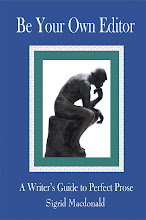
Check out more grammar and writing tips in my book Be Your Own Editor.

Friday, January 6, 2012

Today's Writing Tip Is When to Use Cultured versus Cultural

Cultured usually means refined or enlightened, unless we are referring to cultured yogurt. Cultural refers to someone with an artistic nature, or different ethnic groups.

Thus, when we're talking about multiculturalism, we can say, "Ottawa has a great deal of cultural diversity." And when we're talking about someone who loves opera, ballet, and musicals, we can say he or she is very cultured. We don't want to say that a city is cultured unless we mean that it has fine arts, dining, and music, but don't use the term cultured to refer to different ethnicities. That is a common mistake, but I know that you are just too cultured to make it!

Learn more about word usage in my third book, Be Your Own Editor. When should you use between or among, further and farther, or complement and compliment? Find out in BYOE, available on Amazon.com in print and now a bestseller on Kindle. (http://tinyurl.com/4v249th)

Sigrid Macdonald


Tuesday, November 22, 2011

Today's Writing Tip Is When to Omit the Word of

When I grew up, it was considered acceptable to say, "Half of all the people in the room seemed to be asleep." Nowadays, we streamline language. We have removed the "s" from words like towards, backwards, and afterwards. We’ve shortened the word amidst to amid. And we are removing the term of in many phrases.

Get off of my lawn!
All of my children are studious.
Half of the profits are yours.

All those sentences – note that I didn’t say all of those! – can be rewritten without the word of.

This is a hard rule to remember. What I do is write whatever comes into my head and then when I’m rereading and revising my material, I go back and look for the number of times that I used of.

Of course, sometimes of is essential. Here are sentences that wouldn't make any sense without it: "The floor is made of pine wood." "The dog is tired of his regular biscuits." "I'm writing a book composed of grammar tips." Those sentences all require the preposition of. So, use your good judgment and double-check your work to remove filler words like of.

Sigrid Macdonald is the author of three books, including the Amazon bestseller Be Your Own Editor, available on Kindle as well as in print. http://tinyurl.com/6oobf97  She is also the winner of Grammar.net’s Best Grammar Writing Tips Blog of 2011.


Monday, November 21, 2011

Friday, November 11, 2011

Today's Writing Tip Is the Plural of Flu

Talking about the flu is different from talking about having a cold. One person can have a cold but the whole family may have an immunity to colds in general. That is to say, the plural of cold is colds just as the plural of virus is viruses. But the plural of flu is not flus.

Flu is short for influenza and for some inexplicable reason, the plural and singular form of this word are the same –

"I had the flu in October."
"I like to avoid people with colds and flu."

You’re safe to use the word flu in the plural or you can say influenzas. This is one of those odd grammar rules that we just need to commit to memory, much like the Advil rule. I used to say that I took two Advil but once again the singular and the plural of that word are identical – whether you take one or 100 Advil, you don't want to add that “s” but I wouldn't suggest taking that many no matter how bad your flu is!

Sigrid Macdonald is a manuscript editor and the author of three books, including Be Your Own Editor. Buy now on Amazon Kindle for $2.99.


Sunday, October 30, 2011

Today's Writing Tip Is When to Use I Think and I Feel

People often use the term "I feel" when it's inappropriate. Feelings relate to emotions, such as sorrow, rage, or jubilation. "I feel excited" or "I feel worried" is correct. Feelings can also relate to body temperature. "I'm freezing. I feel so cold!"

Thoughts are part of our internal dialogue. "I think, therefore, I am," the great philosopher Descartes said. You can use the word think when you're talking about anything mental. Here's an example: "I think the snowstorm that just bombarded the north-eastern US may be on its way to Canada." You don't want to say, "I feel the snowstorm in the US may be on its way to Canada."

Using "I think" and "I feel" correctly is just a matter of paying attention. When you're aware that you have a tendency, as many of us do, to write "I feel" rather than "I think," you'll be more apt to be on the lookout for this construction.

Meanwhile, I hope that none of my readers were affected by that storm!

Sigrid Macdonald is a manuscript editor and the author of three books, including Be Your Own Editor, currently available on Amazon Kindle.

Saturday, October 22, 2011

Today's Writing Tip Is When to Use Male and When to Use Man

Sometimes it's hard to know when the word male or man would be a better choice. Generally, male is better used as an adjective and man as a noun. Here are some examples:  

The male soccer team performed well last year.

BUT

At the party, the men stood on one side of the room and the women stood on the other.

Can you say that the males stood on one side of the room? Yes, because male is also a noun, but Grammar Girl recommends using men for people and males for scientific purposes or when referring to animals. In that case, you can say, “The giraffes couldn't reproduce because the zoo only had males.”

Sigrid Macdonald is an editor and the author of three books, including Be Your Own Editor available on Amazon Kindle: http://tinyurl.com/5sgs72p .


Free Search Engine Optimization