If you're interested in expanding your vocabulary, understanding homonyms, and learning a word a day,check out Grammar Net. It's a fantastic resource. Don't forget to subscribe to their grammar newsletter.
http://www.grammar.net/
Sunday, September 18, 2011


Sunday, July 3, 2011
Number 2 in Editing, Grammar, and Journalism
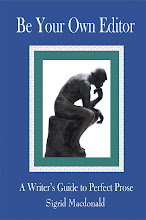
Be Your Own Editor is now rated #2 on Amazon Kindle in the editing, grammar, and journalism department. Download your copy for $2.99 now:
http://www.amazon.com/Be-Your-Own-Editor-ebook/dp/B003LBS7OQ/ref=zg_bs_158273011_4
http://www.amazon.com/Be-Your-Own-Editor-ebook/dp/B003LBS7OQ/ref=zg_bs_158273011_4
Saturday, July 2, 2011
Today's Writing Tip Is on Grammar-Free Zones
Writing properly can be exhausting. There are times when we don’t want to check for every typo, misplaced modifier or dangling participle. Sometimes we’re just plain off duty.
I usually consider myself to be off duty in social e-mail, in text messages, and on Facebook, but that’s because I don’t use Facebook for work. If you use social networking sites like Facebook or Twitter to promote your business or products, including books, by all means take time to write properly. By definition, LinkedIn is a professional networking group and you want to present yourself well there. And if you have a blog that you use to promote your most recent book, or a product or service, and you have followers, you’re still on duty.
But if you are chatting back and forth with your friends in e-mail or on Facebook, you don’t always have to take the time to proof everything. Discussion threads on Facebook can be long, and the forum itself may interfere with productivity. That’s why some workplaces have completely blocked access.
When it comes to proofreading and writing well, use your own judgment. And it doesn’t hurt to automatically configure your spell-check to proof every e-mail before it goes out, so that people aren’t scratching their heads wondering what you meant by the word “hur” (her, hurt, hurry?).
Happy writing, and take some time off from the grammar world
Sigrid
Author of Be Your Own Editor
http://sigridmacdonald.blogspot.com/
I usually consider myself to be off duty in social e-mail, in text messages, and on Facebook, but that’s because I don’t use Facebook for work. If you use social networking sites like Facebook or Twitter to promote your business or products, including books, by all means take time to write properly. By definition, LinkedIn is a professional networking group and you want to present yourself well there. And if you have a blog that you use to promote your most recent book, or a product or service, and you have followers, you’re still on duty.
But if you are chatting back and forth with your friends in e-mail or on Facebook, you don’t always have to take the time to proof everything. Discussion threads on Facebook can be long, and the forum itself may interfere with productivity. That’s why some workplaces have completely blocked access.
When it comes to proofreading and writing well, use your own judgment. And it doesn’t hurt to automatically configure your spell-check to proof every e-mail before it goes out, so that people aren’t scratching their heads wondering what you meant by the word “hur” (her, hurt, hurry?).
Happy writing, and take some time off from the grammar world
Sigrid
Author of Be Your Own Editor
http://sigridmacdonald.blogspot.com/
Sunday, May 22, 2011
Today's Writing Tip Is Take a Listen
Over the last year or two, I’ve heard a number of newscasters use the expression, "take a listen." I don't know where that came from. Why do we need two verbs? Why not just say, "Listen"?
There are other instances where people routinely use two or even three verbs. "Alejandro was going to go see his mother." A cleaner version of that sentence would be: "Alejandro was going to see his mother.”
Be aware when you're using more words than necessary. Simplicity allows your message to come through clearly without any distractions.
There are other instances where people routinely use two or even three verbs. "Alejandro was going to go see his mother." A cleaner version of that sentence would be: "Alejandro was going to see his mother.”
Be aware when you're using more words than necessary. Simplicity allows your message to come through clearly without any distractions.
Friday, May 13, 2011
The Art and the Gift of the Review by Nanci Arvizu

Page Readers
Nanci Arvizu
The Art and the Gift of the Review.
Writers and Reviewers
As a reviewer at Page Readers, I am open to reading just about any kind of genre. Of course I have some that I like more than others, and some I shy away from completely, but if a title catches my eye and the description of the book sounds good I will read it regardless of the genre.
But what happens when a book I’ve agreed to read and write a review for turns out, in my opinion, to be less than “breathtaking,” “mesmerizing,” or “one I couldn’t put down?” Do I only share the positives that I can find in the work to create my review? Or do I put it all out there, the good, the bad and even the ugly for the world to see?
Tough questions. When I’ve received a book from an author, especially when they’ve gone to the trouble and expense of sending me a print book, I feel as though I owe them my honest opinion. If the work turns out to be something that totally saddles my horse, I post it everywhere knowing the author will appreciate the accolades. When the saddle doesn’t fit, am I required to lie and say it’s fine? Ever ridden in a saddle that doesn’t fit you or your horse? Let’s just say it doesn’t work. Your hide will be chapped for days.
There has been much buzz lately about a certain author (who shall remain nameless) who badmouthed a reviewer on the reviewers’ blog, because he stated a fact: the book was filled with editing errors. He admitted to enjoying the story. The author accused the reviewer for not downloading the correct version of her book from her sales site on Smashwords. The comment thread was probably one of the longest I’ve ever seen - and I read every comment right up to where the owner of the blog stopped allowing comments altogether.
The author blamed the reviewer not downloading an updated version of her work. Since when is it the readers’ responsibility to make sure they have a final draft of a book?
As a writer myself, of course I want the words I put down on paper to mean something. Will they mean the same thing to every person who reads them? Wouldn’t it be something if every time I shared a story, an article or opinion about anything that the world clamored to read it and shot from roof tops screaming, “this was the best thing I’ve ever read!”
When we put pen to paper weaving our imaginations into tales, or even retell a much-repeated tale in our own words, not everyone is going to “get it.” Authors need to have a thick skin and understand their work will not appeal to every single person -- even if only a single person reads it.
Be brave. Write it anyway. Get feedback. Know that with honest input (you don’t even have to call it criticism) your skills as an author will only improve. Believe in yourself.
But never ever lose your temper over a bad review of your work. If you can’t handle the ride, don’t get the horse out of the barn.
Nanci Arvizu
Host of Page Readers on Blog Talk Radio
Reviewer at Page Readers blog
V.P. Promotion a la Carte
http://promotionalacarte.com/
Submit your Apocalypse 2012 Short Story for this exciting PAC Contest.
Monday, May 2, 2011
Today's Writing Tip Is on Clichés
One day at a time.
A heart of gold.
Slow and steady wins the race.
He just got a slap on the wrist.
These are all clichés that you don't want to use in your writing because they’re trite and overused.
I always recommend writing the first draft of your story, article, essay, blog post or manuscript in a loose style. Get those thoughts out of your head and down on paper. Don't worry about grammar, facts, or details that may slow you down. Having a completed work is such a great feeling; it makes it much easier to return to refine your material. That’s when you want to go through it with a fine tooth comb—just testing you. That's a cliché! Let's paraphrase that: that’s when you want to assess your material to remove too many adverbs, adjectives, and stale or outdated expressions.
By trimming your work and using crisp and unique terms, you’ll take a good piece of writing and make it brilliant.
Read more about punctuation in my third book, Be Your Own Editor, available in print (http://tinyurl.com/3xkoths) and now a bestseller on Kindle (http://tinyurl.com/3y3nuzb). Or get 20% off the regular price by writing directly to me.
A heart of gold.
Slow and steady wins the race.
He just got a slap on the wrist.
These are all clichés that you don't want to use in your writing because they’re trite and overused.
I always recommend writing the first draft of your story, article, essay, blog post or manuscript in a loose style. Get those thoughts out of your head and down on paper. Don't worry about grammar, facts, or details that may slow you down. Having a completed work is such a great feeling; it makes it much easier to return to refine your material. That’s when you want to go through it with a fine tooth comb—just testing you. That's a cliché! Let's paraphrase that: that’s when you want to assess your material to remove too many adverbs, adjectives, and stale or outdated expressions.
By trimming your work and using crisp and unique terms, you’ll take a good piece of writing and make it brilliant.
Read more about punctuation in my third book, Be Your Own Editor, available in print (http://tinyurl.com/3xkoths) and now a bestseller on Kindle (http://tinyurl.com/3y3nuzb). Or get 20% off the regular price by writing directly to me.
Sunday, April 24, 2011
Polish your Writing and Produce Professional Copy
Be Your Own Editor is a best-selling reference manual, rated #25 in the editing category on the Amazon Kindle Store and among the Top 100 Paid Books on Kindle. It's an informal crash course on grammar and writing basics, written by a combination author and editor. BYOE is meant as a guidebook for students and writers of all ages and stages, and incorporates humor as well as pop quizzes to help you learn in the least painful manner possible. The book is available on Amazon.com for $14.00. [http://tinyurl.com/4qgef2j ] The Kindle version is only $3.99. [http://tinyurl.com/4b8taao ]
The print book is $9.99 by ordering directly through me, not including shipping and handling, and the e-book is $3.99. If you're a student, let me know and I'll give you a 10% discount -- no questions asked.
Sigrid (sigridmac at rogers.com).
P. S. Check out my editing website, too, at http://sigridmacdonald.blogspot.com.
***
In today's high-tech world, we're all writers. Long gone are the days of Mad Men when executives dictated letters to their secretaries. Nowadays, we're all connected 24/7 through our BlackBerrys, laptops, and notebooks. We're on e-mail, social networking sites, blogs, ad infinitum. If you write directly to an administrator or exec, you may very well hear back from that person, which would have been unheard of 20 years ago.
We write in order to sell on the Internet, to keep in touch with our children who are away at college, or to discuss issues on message boards. Professional writers develop manuscripts, write short stories, and devise query letters and book proposals. Students, much to their dismay, write essays on a deadline. The end result is that everyone is a writer.
Writing is like breathing, eating or sleeping in the sense that we all do it, but how well do we do it? In that respect, it's more like driving a car. Some people drive very well. They were taught the basics, took the responsibility seriously, studied the rules, and have driven for so many years that it's become second nature. Others learned by the seat of their pants. They accepted the recommendations that seemed most critical at the time (e.g., always stop at a red light!), and have been driving for so many years that they've forgotten some of the essentials. Ditto for English grammar and composition.
E-mail has become pretty relaxed. We understand that people are in a hurry and they deal with dozens, if not hundreds, of e-mails every day, so we cut them some slack. Not so of websites. Selling something? One or more typos on your site can seriously undermine your customers' faith in your intelligence, and consequently your product or service, even if both are stellar. And if you're submitting articles for publication or circulating your CV in the hope of obtaining a job, you had better have clean copy.
I've always been a writer, starting back in my teens. And I was fairly confident about my grammatical skills until I became a copy editor. Then I began to take grammar seriously and realized how much I didn't know. So, I went back to the beginning to teach myself the core concepts. It sounded like a real yawner and I wasn't excited about it at all. But, guess what? It turned out to be a lot of fun, because grammar has certain rules that will always remain the same, much like math.
Be Your Own Editor provides the crash course in writing basics that I wish I’d had at my disposal. It lists the most common mistakes I've encountered while editing 60 full-length fiction and nonfiction books. Run-on sentences, misuse of apostrophes, word confusion — should you use effect or affect? Loath or loathe? Like or as if? When should you use a colon and when should you use a semicolon? Are serial commas preferred to regular commas? Find out.
In addition to being a copy editor, I also act as a book coach. I help people create their stories, thus, I've devoted part of Be Your Own Editor to discussing character development, credible dialogue, plot resolution, and how to write captivating background details for fiction. For nonfiction, I've discussed organization, content, clarity, the importance of up-to-date references and how to avoid overkill.
What about your spell-check? Why do you need a book on editing when you can just push F7? The spell-check is a phenomenal device; I couldn't live without it. However, it's far from perfect. And it doesn't work like a calculator. If you hit all the right buttons on a calculator, and ask it to perform the correct function, it's 100% accurate. Not so with your spell-check. The English language has too many homonyms, such as "they're, there and their." Any one of those words could be spelled correctly in your document but misused, and the spell-check may tell you it’s okay. If you say that you "through" the ball out the "widow," there is no way for your program to tell you that that's wrong. Typos are easy to make and after we've spent hours, if not months (or even years, in the case of books), pouring over the same material, sometimes our brain just takes a vacation and we can't spot our own mistakes. The spell-check won't help in this case but the recommendations in Be Your Own Editor will.
Still afraid that you can't edit your own copy? That you'll miss something? I make a number of suggestions about how to find qualified people to review your final draft for very little money or for free.
All these and more are covered in 156 reader-friendly pages. This is not a stuffy English textbook. Far from it. I try to make you laugh from time to time, and have included three pop quizzes, so you can test your knowledge of punctuation or word usage at the end of certain chapters.
Anyone can benefit from the tools in this book because we're all writers. But professional writers in particular—writers who want to submit their material to agents and publishers—and students will find helpful tools to improve their current skills, along with recommendations about which books constitute the best reference material.
In fact, I'm so convinced that Be Your Own Editor will be useful to you that I'm offering a money-back guarantee. If you don't learn anything whatsoever in this book, write to me and I'll be happy to refund your purchase.
Meanwhile, happy writing.
Sigrid
Buy Be Your Own Editor directly through me by hitting the Contact Me button or sending an e-mail to sigridmac at rogers.com. Or simplifiy your life and get it on PayPal.


The print book is $9.99 by ordering directly through me, not including shipping and handling, and the e-book is $3.99. If you're a student, let me know and I'll give you a 10% discount -- no questions asked.
Sigrid (sigridmac at rogers.com).
P. S. Check out my editing website, too, at http://sigridmacdonald.blogspot.com.
***
In today's high-tech world, we're all writers. Long gone are the days of Mad Men when executives dictated letters to their secretaries. Nowadays, we're all connected 24/7 through our BlackBerrys, laptops, and notebooks. We're on e-mail, social networking sites, blogs, ad infinitum. If you write directly to an administrator or exec, you may very well hear back from that person, which would have been unheard of 20 years ago.
We write in order to sell on the Internet, to keep in touch with our children who are away at college, or to discuss issues on message boards. Professional writers develop manuscripts, write short stories, and devise query letters and book proposals. Students, much to their dismay, write essays on a deadline. The end result is that everyone is a writer.
Writing is like breathing, eating or sleeping in the sense that we all do it, but how well do we do it? In that respect, it's more like driving a car. Some people drive very well. They were taught the basics, took the responsibility seriously, studied the rules, and have driven for so many years that it's become second nature. Others learned by the seat of their pants. They accepted the recommendations that seemed most critical at the time (e.g., always stop at a red light!), and have been driving for so many years that they've forgotten some of the essentials. Ditto for English grammar and composition.
E-mail has become pretty relaxed. We understand that people are in a hurry and they deal with dozens, if not hundreds, of e-mails every day, so we cut them some slack. Not so of websites. Selling something? One or more typos on your site can seriously undermine your customers' faith in your intelligence, and consequently your product or service, even if both are stellar. And if you're submitting articles for publication or circulating your CV in the hope of obtaining a job, you had better have clean copy.
I've always been a writer, starting back in my teens. And I was fairly confident about my grammatical skills until I became a copy editor. Then I began to take grammar seriously and realized how much I didn't know. So, I went back to the beginning to teach myself the core concepts. It sounded like a real yawner and I wasn't excited about it at all. But, guess what? It turned out to be a lot of fun, because grammar has certain rules that will always remain the same, much like math.
Be Your Own Editor provides the crash course in writing basics that I wish I’d had at my disposal. It lists the most common mistakes I've encountered while editing 60 full-length fiction and nonfiction books. Run-on sentences, misuse of apostrophes, word confusion — should you use effect or affect? Loath or loathe? Like or as if? When should you use a colon and when should you use a semicolon? Are serial commas preferred to regular commas? Find out.
In addition to being a copy editor, I also act as a book coach. I help people create their stories, thus, I've devoted part of Be Your Own Editor to discussing character development, credible dialogue, plot resolution, and how to write captivating background details for fiction. For nonfiction, I've discussed organization, content, clarity, the importance of up-to-date references and how to avoid overkill.
What about your spell-check? Why do you need a book on editing when you can just push F7? The spell-check is a phenomenal device; I couldn't live without it. However, it's far from perfect. And it doesn't work like a calculator. If you hit all the right buttons on a calculator, and ask it to perform the correct function, it's 100% accurate. Not so with your spell-check. The English language has too many homonyms, such as "they're, there and their." Any one of those words could be spelled correctly in your document but misused, and the spell-check may tell you it’s okay. If you say that you "through" the ball out the "widow," there is no way for your program to tell you that that's wrong. Typos are easy to make and after we've spent hours, if not months (or even years, in the case of books), pouring over the same material, sometimes our brain just takes a vacation and we can't spot our own mistakes. The spell-check won't help in this case but the recommendations in Be Your Own Editor will.
Still afraid that you can't edit your own copy? That you'll miss something? I make a number of suggestions about how to find qualified people to review your final draft for very little money or for free.
All these and more are covered in 156 reader-friendly pages. This is not a stuffy English textbook. Far from it. I try to make you laugh from time to time, and have included three pop quizzes, so you can test your knowledge of punctuation or word usage at the end of certain chapters.
Anyone can benefit from the tools in this book because we're all writers. But professional writers in particular—writers who want to submit their material to agents and publishers—and students will find helpful tools to improve their current skills, along with recommendations about which books constitute the best reference material.
In fact, I'm so convinced that Be Your Own Editor will be useful to you that I'm offering a money-back guarantee. If you don't learn anything whatsoever in this book, write to me and I'll be happy to refund your purchase.
Meanwhile, happy writing.
Sigrid
Buy Be Your Own Editor directly through me by hitting the Contact Me button or sending an e-mail to sigridmac at rogers.com. Or simplifiy your life and get it on PayPal.
Subscribe to:
Posts (Atom)